

ISDC 2026 Speaker David Jun Yang: Why Water May Become the Missing Infrastructure Behind AI and Space Systems
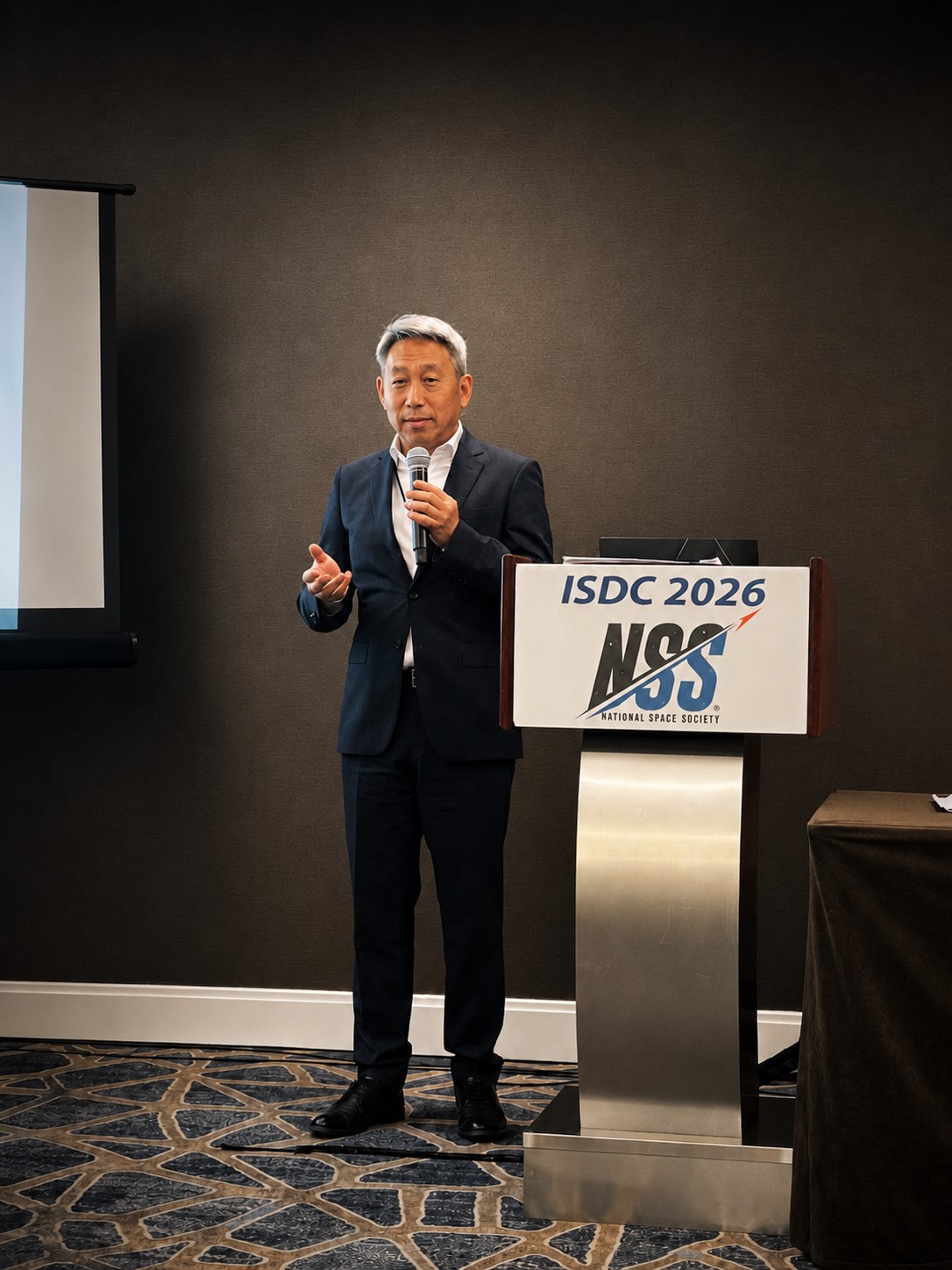
David Jun Yang speaks at the International Space Development Conference (ISDC 2026), presenting his perspective on thermal infrastructure and the role of water in future AI and space systems.
The Compute-Water Flywheel reimagines water as the "thermal currency" for AI and future lunar ecosystems.
From hyperscale data centers on Earth to future lunar infrastructure, cooling efficiency and thermal stability are becoming increasingly critical to the economics of intelligence and long-term space development. As AI infrastructure expands, the cost of cooling itself is becoming an increasingly important component of total energy consumption. At planetary scale, growing heat loads and cooling demands are placing additional stress on both infrastructure and ecosystems.
Speaking at the International Space Development Conference (ISDC 2026), sustainability strategist and infrastructure systems expert David Jun Yang argued that water—not energy alone—may become the missing infrastructure connecting AI, cooling, and future space systems.
"For two centuries, civilization was built around energy," Yang said. "In the AI and Space Age, competitive advantage will increasingly belong to those who master heat."
Beyond Compute: The Rise of Thermal Infrastructure
For decades, the technology industry measured progress through two lenses: more power and more compute. But as AI systems scale and data centers grow in size and density, a less visible challenge is moving to the forefront. Heat management is becoming as strategically important as energy generation itself.
From hyperscale cloud facilities on Earth to future space habitats, cooling efficiency is increasingly shaping infrastructure economics, operational resilience, and the long-term scalability of intelligent systems. According to Yang, the next infrastructure race will not be won simply by building larger models or generating more electricity, but by managing heat more effectively.
"Every watt consumed by intelligence ultimately becomes heat," Yang said. "In large power stations, the hydrodynamic balance of the boiler ultimately determines heat-transfer efficiency and power output. The same principle applies to AI infrastructure. The ability to remove heat efficiently increasingly determines the operating limits of silicon." Yang believes this marks a broader transition from energy infrastructure to thermal infrastructure.
"The future of intelligence will not be determined only by how much energy we can produce," he said. "It will be determined by how efficiently we convert energy into sustainable computation."
Water as Infrastructure
According to Yang, water's ability to absorb, transport, and recycle heat makes it uniquely positioned to support the next generation of intelligent infrastructure. In the AI and Space Age, the same molecule that sustains biological life may also become essential to sustaining computation, enabling applications ranging from high-density cooling and oxygen production to agriculture and long-duration human operations.
During his ISDC 2026 presentation, Yang introduced what he calls the "Compute-Water Flywheel," a closed-loop framework connecting AI computation, heat management, water extraction, resource recovery, and life support.
Rather than treating waste heat as a liability, Yang views it as a physical asset. In future closed-loop ecosystems, thermal loads generated by AI systems could become tools for water extraction, resource recovery, and life support. "We are effectively turning our biosphere into a planetary machine room," Yang said. "The question is no longer whether we can generate more power, but whether we can dissipate heat sustainably."
In Yang's framework, waste heat generated by high-density computing is no longer simply an engineering burden. It becomes a usable resource. Water functions simultaneously as a cooling medium, an energy carrier, and a foundation for human sustainability. Yang believes future habitats, whether on Earth or beyond, will increasingly be designed around thermal zones and closed-loop resource systems rather than isolated engineering modules. Such architectures could integrate computation, resource recovery, agriculture, and human habitation into resilient systems capable of supporting both silicon-based intelligence and biological life.
Toward Sustainable Intelligence
Drawing on more than three decades of experience in sustainability and critical resource systems, together with studies in aerospace engineering, artificial intelligence, and computer science, Yang believes the next wave of competitiveness will depend not simply on producing more energy, but on managing heat more intelligently.
His work bridges disciplines that are rarely considered together, connecting energy efficiency, AI infrastructure, water systems, and long-duration space development. Within this framework, the Moon is viewed not merely as a destination for exploration, but as part of a broader infrastructure ecosystem capable of supporting resource cycling, thermal management, and future intelligent systems. Yang believes permanently shadowed regions and lunar water resources may eventually offer strategic advantages for long-duration operations and closed-loop infrastructure, including future concepts for extracting water ice from permanently shadowed lunar regions.
Rather than viewing energy, computation, and life support as separate systems, Yang argues they should be understood as interconnected components of a larger infrastructure ecosystem—one that spans Earth today and may eventually extend into cislunar space.
"The AI and Space Age will require a new generation of infrastructure thinking," Yang said. "We are only beginning to understand what it takes to make intelligence physically sustainable."
About David Jun Yang
David Jun Yang is a sustainability strategist and multidisciplinary researcher exploring the role of water and thermal infrastructure in the future of AI and space systems. Drawing on more than three decades of experience in critical resource systems—including large-scale power station planning, water circulation engineering, heat-transfer systems, energy efficiency, and low-carbon development—his work focuses on how intelligent systems can become physically sustainable over the long term. He presented his latest research on thermal infrastructure and the Compute-Water Flywheel at the International Space Development Conference (ISDC 2026).
Helen Yang
Shanghai Huamei PR Consulting Co. Ltd
+86 135 0185 0749
email us here
Visit us on social media:
LinkedIn
Legal Disclaimer:
EIN Presswire provides this news content "as is" without warranty of any kind. We do not accept any responsibility or liability for the accuracy, content, images, videos, licenses, completeness, legality, or reliability of the information contained in this article. If you have any complaints or copyright issues related to this article, kindly contact the author above.
